
🧠 Med Minute Note: Throughout this post, you’ll see “Med Minute” callouts. These are brief, educational tidbits based on my studies, research, and experience. They are not meant to replace medical advice.
If you read My Pregnancy Discovery story, you know my pregnancy came as a bit of a surprise. In the first few weeks after discovering I was pregnant, I had little opportunity to focus on my pregnancy. In this post, I share the immediate next steps I took in my pregnancy journey and what should ideally be on your radar in the first trimester.
The Typical First Trimester Timeline
All stories are different. But, “traditionally,” in the first trimester most people find out they’re pregnant, tell their partner, make the nutritional adjustments and start the proper supplements (if they haven’t already), consider their desired birth place and schedule an appointment with the respective care provider, get lab work done, have a dating ultrasound, and then decide whether they want to know the gender via NIPT (noninvasive prenatal testing).
“Traditional” First Trimester Timeline:
- Positive pregnancy test
- Telling your partner/support (if available)
- Nutritional adjustments & supplementation
- Selecting and meeting with an obstetric care provider
- Lab work
- Dating ultrasounds
- NIPT & Gender reveal (if you so choose)
My dilemma was that I wanted my partner to be there for my first prenatal appointment. But he had a career-defining next couple of weeks with his upcoming Level 2 (of 3) medical board exam and final audition rotation for residency. I thought it vital to let him finish these before sharing the life-changing news. So, I did things a little out of order.
My Unique First Trimester Order of Operations
I prefer to research, discover, and gather knowledge on my own before having someone explain something I could have found myself. I’m not suggesting that’s the “right” way — it’s just me. So here was my first trimester pregnancy order of operations (this also includes links for steps described in more detail in other posts):
- Positive pregnancy test (x2)
[Learn more about my timing around pregnancy testing in My Pregnancy Discovery.] - Nutritional adjustments & supplementation
[I was already taking a women’s one-a-day & daily folate, but there was much to learn and a prenatal vitamin to choose! Read more on nutrition considerations in pregnancy by exploring First Trimester: Nutrition & Supplements.] - Dating Ultrasounds (x2)
- SneakPeek Gender Reveal
- Blood work
- Telling my partner/support
[If you are struggling to find the right way or time to tell your partner, I did too! If you’re curious, read about How I Told My Partner I’m Pregnant.] - Sharing the News
[The timing and approach to sharing pregnancy news with family, friends, and colleagues is deeply personal. In my Sharing Our Pregnancy News article, I share our approach to when we shared the news, who we told, what we chose to share, and why.] - Choosing a Birth team & Birth place
[Did you know there are options on who you have provide your OB care and where you birth? To learn more, read about Choosing Your Prenatal Care Team & Birthplace.] - NIPT testing
Gender Sneak Peek & Pregnancy Dating
On November 11th, when I confirmed my pregnancy for the second time, I bought a SneakPeek gender reveal test and sent it off for results the next day. I knew my partner, who also likes to have all the facts, would be just as curious to know once he learned of the pregnancy.
But beyond gender, I had a bigger mystery: I had no idea how far along I was.
🧠 Med Minute: The American College of Obstetricians and Gynecologists (ACOG), together with the American Institute of Ultrasound in Medicine (AIUM) and the Society for Maternal–Fetal Medicine (SMFM), recommends that first-trimester ultrasound (through 13 weeks 6 days) is the most accurate method for establishing gestational age. Crown–rump length (CRL) dating during this window is generally accurate within approximately ± 5–7 days, which is why a first-trimester dating scan often takes precedence over menstrual dating when the two differ. It’s a helpful reminder that even our best tools have a small margin of normal variation—something worth keeping in mind when conversations about due dates and delivery timelines begin.
So, I set out to schedule an elective dating ultrasound.
To my surprise, it was relatively easy to find private prenatal ultrasound clinics near me with experienced technicians. I booked a morning appointment for Friday, November 15th. I figured I was somewhere between 7 to 9 weeks pregnant, but honestly, I was not sure.
First Ultrasound Experience
I felt weird going alone. Ideally, I would have loved my partner to be there, but I was determined to protect his focus for the next few weeks and needed to know how far along I was to determine how soon I needed to see my prenatal care team.
I knew what to expect during this first ultrasound. I had performed several prenatal ultrasounds during my OBGYN medical school rotation a year ago. A reclined table, a little jelly on the lower abdomen, an ultrasound wand, and a display to see it all.
The ultrasound tech started the scan. As she got going, she explained why she had been late that day… “The family dog, Bruno, had gotten into the Halloween chocolate the kids left out…He’s been ill and trying to take care of him…,” I felt awful for her!
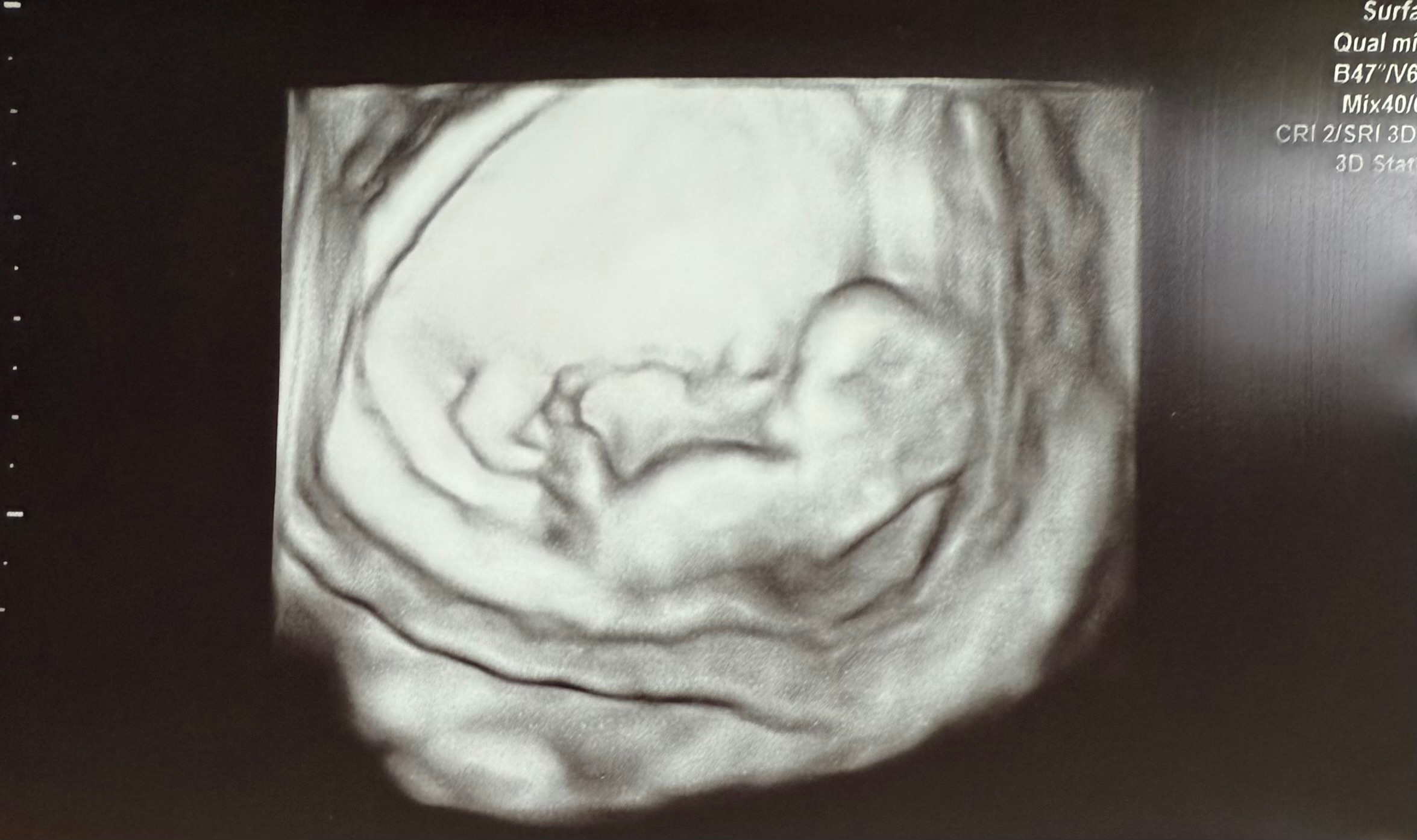
But as I’m listening, I see my baby for the first time as the scan pops up on the screen.
I think, That little baby is inside of me! Just flipping around!
It was amazing. While I expected chaotic excitement, I was filled with a sense of calm. It was like seeing a glimpse, or a picture of someone, I had already met and known forever.
Still talking about her ailing dog, the tech suddenly turned to me and asked, “Is this your first?” I smiled back and said “Yup!” She apologetically replied, “Oh my goodness, well congratulations!”
Estimated Gestational Age
She went on with the measurements and exclaimed, “That’s a big baby in there!”
My heart jumped — what did she mean by big?!
She drew the crown-rump length for the dating calculation.
10 weeks, 5 days. Whoa! I was farther along than I expected.
She finished up her scan, printed out the photos, and apologized for debriefing about her dog. I assured her not to worry, and wished him a full recovery.
Back in the car, I opened the little envelope and stared at the images. I tried to wrap my head around the fact that this tiny being was growing inside me.
Gender Reveal
I returned home and saw the email from SneakPeek arrived at 12:11 pm. It was shaping up to be a day I’d never forget. First time seeing the baby on screen, finding out the gestational age, and discovering the gender!
I sat down on the bed and took a deep breath — reassuring myself I would be happy regardless of the gender. I pressed play on the reveal video…
“It’s a Boy!”
I grinned from ear to ear. Though I had always thought I would want a girl first, I felt so happy. And knew my partner would be thrilled too.
Double Checking the Dates
I started second guessing the estimated gestational age. Was he really already 10 weeks and 5 days?
With the abnormal dates around my last menstrual cycle, I felt the need to reconfirm dating with another ultrasound. I scheduled a second ultrasound at a different location for two days after the first.
This ultrasound was memorable for its own reason. The tech was impatiently waiting for my baby to move into different positions, so she began aggressively jiggling the wand into my lower abdomen to “wake him up.”
The mama bear protectiveness surged.
What was she doing?! She’s going to hurt him!
Later research reassured me that this aggressive “jiggling” is sometimes performed and should not hurt the baby. Regardless, I did not like it happening.
Despite the anxiety from the visit, I got what I needed — a second crown-rump measurement to confirm the date.
11 weeks. Due date: June 8th, 2025.
This was consistent with the dating of the last ultrasound. Now, I felt positive in the estimated gestational age and due date and could use it moving forward.
At this point, my First Trimester Checklist was looking a bit more complete, but I still had much to do.
✔ Positive pregnancy tests
✔ Prenatal nutrition adjustments & supplementation
✔ Pregnancy dated
✔ Gender revealed
Next, I needed to make sure there were no health concerns. If all my lab work was within normal limits, I felt safe to hold off a couple more weeks for my partner to join me at my first prenatal visit.
First Trimester Lab Work
I placed my own orders for health lab work using both questhealth.com and ultalabtests.com. I set my lab collection date for a week from the second ultrasound.
The orders included the following:
- Urinalysis with a reflex culture
- ABO Group and RH Type Test
- CBC with Differential & Platelets
- Total Iron, Iron Binding Capacity, and % Saturation
- Thyroid panel (T3 uptake, T4 Total, Free T4 Index)
- STD Expanded Panel
- Chlamydia
- Gonorrhea
- Syphilis
- HIV-1 and HIV-2
- Hepatitis B
- Hepatitis C
- Trichomoniasis
- CMV Antibody IGG/IGM Titers
- Rubella Antibody IGG Titers
- Toxoplasma (NOTE: This is not usually routinely ordered, but I ordered this one for peace of mind. We have 3 cats that were all rescued, which put me at slightly increased risk).
🧠 Med Minute: In medical school, we’re taught the acronym TORCH, a shorthand for a group of infections that can be passed from mother to baby during pregnancy. Traditionally, it stands for Toxoplasmosis, Other (including infections such as listeria, syphilis, varicella, HIV, and parvovirus B19), Rubella, Cytomegalovirus (CMV), and Herpes Simplex Virus (HSV).
These infections are important because, if acquired during pregnancy, they can sometimes lead to congenital abnormalities, developmental delays, pregnancy loss, or other serious complications for the baby. Fortunately, many are uncommon, preventable, or treatable when identified early.
The impact of a TORCH infection depends on several factors, including the specific infection involved, when it occurs during pregnancy, whether it is a mother’s first exposure or a recurrent infection, and how quickly appropriate treatment can be started.
My Results & Importance of a Qualified Interpreter
I started getting my results back within a couple of days. Thankfully, everything was within normal limits…except two tests.
My CMV IGG Antibody (Ab) came back positive.
I almost had a mini panic attack. Had I felt sick at all the past couple of months?
🧠 Med Minute: CMV is one of the infections that when contracted for the first time during pregnancy, there is higher risk of virus transmission to the fetus than for those who have had it before. An episode of reactivation of latent infection can also pose risk to the fetus, but risk is lower than with a primary infection.
After a quick search and reading from the CDC, I discovered that 1 in 3 children in the United States are already infected with CMV by age 5, and over half of adults have been infected with CMV by age 40.
Additionally, the positive result was the IGG Ab, but my IGM Ab level came back within normal limits. This further reassured me that these antibodies were from an old infection.
🧠 Med Minute: When your body fights an infection it creates antibodies. These are proteins produced by the immune system to recognize and neutralize foreign substances, known as antigens. There are different types of antibodies in the body, which also have different abilities. To grossly oversimplify, IgM is the first-line antibody. They are produced in response to an acute (or new/recent) infection to help start the cascade of immune system pathways. After they initiate the fight, they are slowly cleared from the body. IgG is a more specialized antibody produced later in the life of an infection that sticks around in your body to provide long-term “memory” immunity.
I had no signs of an acute or recent infection, so despite a positive IGG level (indicating long-term immunity), I felt reassured by an IGM Ab level found within normal limits (indicating likely no recent/acute infection).
The other result that came back abnormal was my urine culture. 10,000-49,000 Colony-Forming Units (CFU)/mL of Enterococcus faecalis was present. In obstetric care, it is important to treat UTIs, even when asymptomatic, due to the risk they pose to a pregnancy. It is indicated to treat these infections when colonizing bacteria are >/= 100,000 CFU. My numbers were below this, so I was not concerned. In fact, I was very suspicious, too, that the sample had been contaminated and was not a clean catch.
I repeated a urine culture a couple weeks later, and it had no growth of any bacteria. I felt reassured I did not have a UTI, but that the first test was contaminated.
In a future post, I explain how one of my provider’s approach to the original result became my first lesson on using my education to advocate for standard of care.
NOTE: It’s important when ordering your own lab work that you know how to interpret results and implications, or have a provider that can interpret them for you. Certain results that come back abnormal may cause unnecessary stress and anxiety when not interpreted by a medical provider. Additionally, ordering unnecessary tests has the potential to lead to unnecessary work up with substantial financial costs and invasive procedures.
Looking Ahead
During all this — pregnancy dating, gender reveal, lab work, etc.— I continued to research proper prenatal nutrition, things to avoid in pregnancy, and supplements to embrace.
I cover this in my next post, First Trimester: Nutrition & Supplements.
Coming Up
→ How I Told My Partner I’m Pregnant
→ Choosing Your Prenatal Care Team & Birth Place
Where did your pregnancy journey begin? Did you follow the usual steps or, like me, take a different path? I’d love to hear your story, comments, and questions below.