
Choosing a prenatal care team may be as simple as continuing care with your established gynecologist. For many women—especially those planning a traditional hospital birth—that may be the perfect choice.
But if you’re considering a birth center or home birth, or simply want to explore all of your options before deciding, your prenatal care team may look a little different.
As I quickly learned during my own pregnancy, choosing a provider isn’t really the first decision.
The first decision is this:
Where do you envision giving birth?
- Hospital?
- Birth center?
- Home?
Your answer to that question will naturally shape the type of provider who is best suited to care for you throughout pregnancy and delivery.
This is also one of the first opportunities you have as a parent to become an active participant in your healthcare rather than simply following the standard path. There isn’t one “right” choice that fits every pregnancy. Instead, the goal is to find the environment where you will feel safest, most supported, and most confident bringing your baby into the world.
That said, every pregnancy also carries an element of the unexpected.
With the proper preparation and care, many low-risk mothers can achieve births in line with their dream birth plan. At the same time, we cannot ignore that some mothers who hope for a vaginal delivery must deliver by cesarean section, and others who begin pregnancy planning a home birth may require a hospital transfer. Some develop medical conditions during pregnancy that make one birth setting safer than another.
Birth plans should be intentional—but due to the nature of birth, they must remain flexible.
One of the greatest gifts you can give yourself during pregnancy is education. The more you understand your options before labor begins, the more confidently you can advocate for yourself while also adapting if circumstances change.
My encouragement is this:
Take ownership of creating the birth experience you hope for while remaining open and ready for whatever circumstances may arise. Understanding your options before they happen can help you navigate them with greater confidence if they do.
No matter what your birth looks like, there is no failure in adapting if the situation calls for it.
So let’s begin with the first question.
Choosing Your Birth Place
Before choosing your prenatal care provider, I encourage every expectant parent to first consider where they hope to give birth.
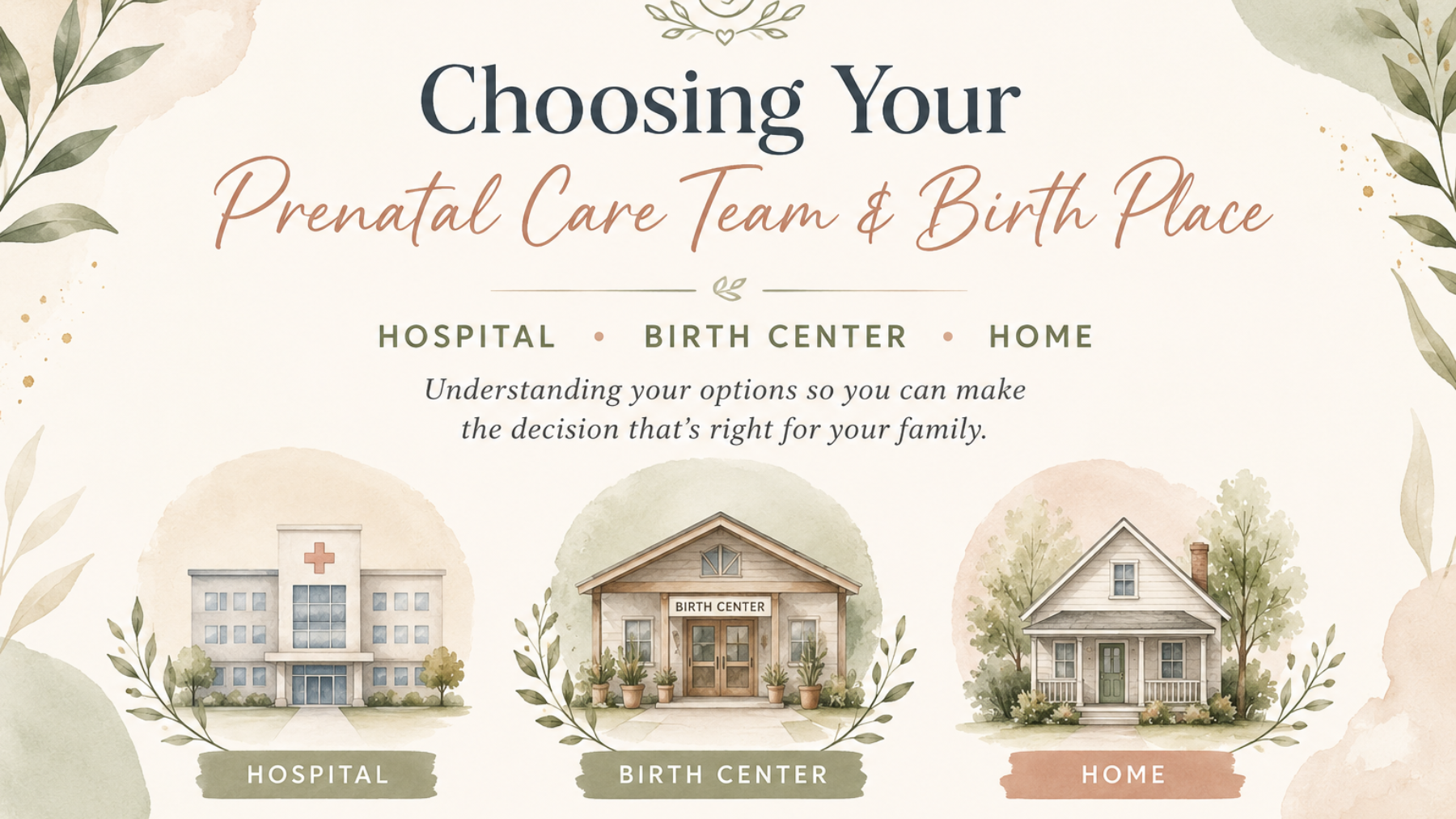
For most families, this decision comes down to three options:
- Hospital
- Freestanding Birth Center
- Home
Each environment offers different philosophies of care, different levels of medical intervention, and different care teams.
None is universally “better” than another.
Each option offers advantages depending on your pregnancy, your health history, your personal values, and your comfort level.
The best choice is the one that aligns with both your medical needs and your personal values. For some families, that answer is obvious. For others, it may require weeks or even months of research, conversations, and reflection—and that’s okay.
Hospital Birth
Hospitals remain the most common birthplace in the United States, and for many families they provide tremendous reassurance.
They offer immediate access to obstetricians, anesthesiologists, operating rooms, neonatal specialists, blood products, and nearly every major medical intervention should complications arise during labor or delivery.
For pregnancies with significant maternal or fetal risk factors, a hospital may be the safest and most appropriate environment.
Even for healthy pregnancies, many mothers simply feel most comfortable knowing that every available resource is immediately accessible if needed.
Because hospitals are equipped to provide these interventions, they also tend to utilize them more routinely than birth centers or home births. I’ll discuss those common interventions—including IV placement, fetal monitoring, cervical examinations, labor augmentation, and cesarean delivery—in a later Med Minute section.
Freestanding Birth Centers
Birth centers provide a beautiful middle ground between the hospital and home.
These centers are designed for healthy, low-risk pregnancies and focus on supporting physiologic labor while still providing a dedicated birth environment outside your home.
Compared with many hospitals, birth centers generally encourage greater freedom of movement during labor, eating and drinking as desired, hydrotherapy (laboring in a shower or tub, with many also offering water birth), and a lower-intervention approach to birth.
Most are staffed by certified nurse-midwives and maintain collaborative relationships with nearby hospitals should transfer become necessary.
For families seeking a more home-like atmosphere while still wanting a separate birth facility, birth centers can be an excellent option.
Home Birth
For some healthy, low-risk mothers, home is exactly where they feel safest.
A planned home birth is very different from an unplanned birth at home. It is a carefully prepared event attended by trained midwives who bring medications, emergency equipment, and supplies to monitor both mother and baby throughout labor.
Many families are drawn to home birth because it allows labor to unfold in a familiar environment with maximal privacy, freedom of movement, and minimal routine intervention.
Home birth is not appropriate for every pregnancy, and depending on medical history or pregnancy complications, another setting may provide a safer environment.
For our family, after significant research, conversations, and reflection, home birth ultimately became the right fit.
In my next post, I’ll share the journey that led us there, how I decided on my team, and why we ultimately felt confident making that decision.
🧠 Med Minute: Understanding Common Hospital Birth Interventions
If you’re considering a hospital birth, you’ll likely hear a number of terms throughout pregnancy and labor that may be unfamiliar at first. It’s important to remember that an intervention is not inherently good or bad. Many interventions are lifesaving when medically indicated, while others may be offered more routinely depending on your provider, hospital policies, and the progression of labor.
Understanding what these interventions are, why they are used, and when they may be recommended can help you ask informed questions and make decisions that align with both your medical needs and your birth preferences.
Some of the most common hospital interventions include:
Intravenous (IV) Access
Many hospitals routinely place an IV upon admission to labor and delivery. An IV is started by inserting a needle into a vein. The needle is then removed, leaving behind a small flexible catheter that can be connected to IV tubing to administer fluids, medications, antibiotics, oxytocin (Pitocin), or emergency medications if needed.
About 80% of mothers laboring in hospitals can expect routine placement of an IV, though some hospitals may use a saline lock (an IV catheter without continuous fluids—no tubing hooked up, just the tiny tube remaining in the vein).
Continuous Electronic Fetal Monitoring (EFM)
Electronic fetal monitoring tracks your baby’s heart rate and your contractions throughout labor.
Evidence has not consistently shown continuous electronic fetal monitoring to improve neonatal outcomes in healthy, low-risk pregnancies compared with intermittent auscultation. And in low-risk labors, continuous EFM has been associated with higher rates of cesarean delivery (approximately 63% relative increase) and operative vaginal birth (approximately 15% relative increase) compared with intermittent auscultation.
Regardless, about 85% of mothers laboring in the hospital setting can expect to be continuously hooked up to electronic fetal monitoring. For low-risk pregnancies, intermittent auscultation (periodically listening to the baby’s heartbeat) can be an appropriate option, depending on your provider and birth setting.
Cervical Examinations
Vaginal examinations help assess cervical dilation, effacement, and the baby’s position during labor.
While they provide useful information on how far along a mother is, they do not dictate how much time is left to delivery. The frequency of cervical exams varies among providers and birth settings, and mothers should always feel empowered to discuss the necessity and timing of these examinations with their healthcare team.
Labor Induction and Augmentation
For healthy pregnancies, spontaneous labor is the physiologic process the body is designed to initiate. At times, labor is medically induced or strengthened (augmented) when it has been determined that continuing the pregnancy or allowing labor to progress naturally poses greater risks.
Common methods used to induce or strengthen labor include medications such as oxytocin (Pitocin), cervical ripening agents, artificial rupture of membranes (breaking the water), or mechanical methods such as a balloon catheter. Oxytocin (Pitocin) may also be administered after delivery to help the uterus contract, reducing postpartum bleeding and lowering the risk of postpartum hemorrhage.
Each has specific benefits, risks, and appropriate clinical indications.
Epidural Analgesia
An epidural is one of the most effective methods of labor pain relief and is chosen by many mothers. An epidural is placed by inserting a needle into the lower back until it reaches the epidural space surrounding the spinal canal. The needle is then removed, leaving behind a small catheter that continuously delivers pain-relieving medication.
Some women know before labor that they want an epidural. Others prefer to labor without one or make that decision as labor unfolds.
Although epidural analgesia has been associated in many studies with longer labors and increased rates of operative vaginal delivery, it’s important to remember that association does not mean those who receive an epidural will experience these outcomes. Many women still go on to have uncomplicated vaginal births with effective epidural pain relief.
Cesarean Delivery
Cesarean birth is a major abdominal surgery performed when a vaginal birth would pose greater risk to the mother, the baby, or both.
While many cesarean deliveries are unplanned, they are often lifesaving procedures that have dramatically improved maternal and neonatal outcomes. Cesarean delivery rates can vary from hospital to hospital, as well as in birth setting. Overall, approximately one in three births in U.S. hospitals occurs by cesarean delivery, while planned births at freestanding birth centers and at home among carefully selected low-risk pregnancies often report cesarean rates under 10%. It is important to recognize that these differences do not necessarily reflect the birth setting alone. Women planning home births and birth center births are carefully selected as healthy, low-risk candidates, while hospitals care for the full spectrum of low-, moderate-, and high-risk pregnancies.
Regardless, understanding when a cesarean may become medically necessary can help reduce fear should labor ultimately take an unexpected course.
Remember…
Learning about these interventions will help you understand why they may be recommended, recognize when they are medically necessary, and feel confident discussing your options with your healthcare team.
Education allows you to approach birth with preparation rather than fear—and flexibility rather than disappointment if your birth unfolds differently than planned.
Choosing Your Prenatal Care Team
Once you’ve thought about where you hope to give birth, the next step is deciding who you would like guiding you throughout your pregnancy.
Depending on your chosen birth setting, your options may include an obstetrician (OB), certified nurse-midwife (CNM), certified professional midwife (CPM), licensed midwife (LM), or a collaborative team of providers. You may also choose to hire a doula to provide continuous physical, emotional, and informational support throughout labor and birth.
Each plays a different role, has different training, and practices within different birth settings. Understanding these differences can help you choose the team that best aligns with your pregnancy, your values, and your birth goals.
Remember that your prenatal care provider and your birth setting often go hand in hand, but they don’t always have to. Depending on your circumstances, some families intentionally build a collaborative team that draws on the strengths of multiple professionals.
Obstetrician (OB)
Obstetricians are physicians who specialize in pregnancy, labor and delivery, and women’s reproductive health. They complete four years of medical school followed by a four-year residency in obstetrics and gynecology, where they receive extensive training in both routine prenatal care and the diagnosis and management of high-risk pregnancies.
OBs are uniquely qualified to care for women with complex medical conditions or pregnancies complicated by maternal or fetal concerns. They are also trained to perform operative vaginal deliveries, cesarean sections, and other surgical procedures that may become necessary during pregnancy or birth.
Many healthy, low-risk women also choose an obstetrician simply because they appreciate the reassurance of physician-led care or have a previously established relationship with their gynecologist.
Midwives
The term “midwife” actually encompasses several different credentials, each with its own education, scope of practice, and typical birth setting.
Certified Nurse-Midwife (CNM)
Certified nurse-midwives are advanced practice registered nurses who complete graduate-level midwifery education and national certification. They provide comprehensive prenatal, labor, birth, and postpartum care and are licensed to practice in all fifty states.
CNMs can also prescribe medications, including antibiotics, pain medications, and many other prescription medications, though their prescriptive authority varies somewhat by state law and practice setting.
CNMs most commonly attend births in hospitals and birth centers, although in some states they may also attend or specialize in home births.
For healthy, low-risk pregnancies, CNMs often emphasize physiologic birth while still maintaining access to medical consultation and collaboration when needed.
Certified Professional Midwife (CPM) / Licensed Midwife (LM)
Certified professional midwives are educated specifically in out-of-hospital birth and are trained to care for healthy, low-risk pregnancies.
Because licensure laws vary by state, you may also see the title Licensed Midwife (LM). In many states, CPMs become licensed as LMs after meeting state-specific requirements. While the exact credential depends on where you live, both generally specialize in community birth settings such as homes and freestanding birth centers.
These midwives are experts in supporting normal physiologic birth while also recognizing when consultation or transfer to a hospital is appropriate.
Because state regulations vary, it can be useful for families considering community birth to become familiar with the credentialing and licensure requirements in their own state.
Collaborative Care
Choosing a prenatal care team doesn’t always mean choosing just one provider.
Some families receive prenatal care from an obstetrician while planning to deliver with a midwife. Others establish care with a midwife while also consulting a maternal-fetal medicine specialist for specific medical conditions. Some practices function as a collaborative group, meaning you may meet with several providers throughout your pregnancy and any one of them may attend your birth depending on who is on call.
For some families, collaborative models offer the benefits of both physiologic pregnancy care and specialized medical expertise when appropriate.
Doulas
Unlike physicians and midwives, doulas do not provide medical care or perform clinical procedures during pregnancy, labor, or birth.
Instead, their primary role is to provide continuous emotional, physical, and informational support throughout pregnancy, labor, birth, and the postpartum period.
A doula may help you develop a birth plan, create an environment that supports labor, provide comfort measures and encouragement, help your partner feel more confident in supporting you, and advocate for your preferences by facilitating communication between you and your healthcare team.
Research has shown that continuous labor support from a trained doula is associated with a number of positive birth outcomes and greater maternal satisfaction. While doulas are not essential for every family, many parents find them to be an invaluable addition to their birth team.
📌 An Additional Note: Dedicated Provider vs. Laborist / On-Call Model
One final consideration is who will actually be present when your baby is born.
Some practices follow a traditional model in which your own obstetrician or midwife provides your prenatal care and, whenever possible, will be the provider supporting your delivery.
Others use a laborist or “call-group” model, meaning the provider on call when you arrive in labor may be another physician or midwife within the practice whom you’ve met previously—or someone you’re meeting for the first time.
While some families initially prefer having one familiar provider throughout pregnancy and birth, the laborist model also offers advantages. The physician or midwife attending your birth is typically working a dedicated labor shift rather than coming in after a full day of clinic or being awake for many consecutive hours.
Neither approach is inherently better.
Some families appreciate the continuity of seeing the same provider throughout pregnancy and birth, while others value knowing that whoever is on call is rested and dedicated solely to caring for laboring patients.
If continuity of care is important to you, this is a wonderful question to ask during your initial consultation with a practice.
📋 Questions to Ask During Your Consultation
As you meet with potential providers, consider asking:
- Do you attend births in the birth setting where I hope to deliver (hospital, birth center, or home)?
- Who is most likely to attend my birth?
- Do you work within a call group or laborist model?
- Will I have the opportunity to meet everyone who may attend my delivery?
- How do you typically handle emergencies or transfers if they become necessary?
- If planning a birth center or home birth, what is your transfer rate, and under what circumstances do transfers most commonly occur?
- At what point in pregnancy do you typically begin discussing or recommending induction of labor for a healthy, low-risk pregnancy? Under what circumstances would you feel comfortable waiting until 41 or 42 weeks if maternal and fetal surveillance remained reassuring?
- How do you approach common hospital practices such as IV placement, continuous electronic fetal monitoring, eating and drinking during labor, freedom of movement, and cervical examinations?
- How do you incorporate patient preferences and birth plans into your care when it is safe to do so?
🌿Where Medicine Meets Motherhood
One of the greatest lessons medical school taught me is that medicine is both a science and an art.
The science of medicine relies on evidence gathered from large populations to identify the safest and most effective approaches to care. It seeks to reduce risk, recognize complications early, and protect the lives of both mother and baby.
The art of medicine reminds us that no two patients are exactly alike.
Each mother enters pregnancy with her own health history, values, goals, comfort level, and vision for birth. Good medicine isn’t simply about applying population-based evidence—it’s about thoughtfully applying that evidence to the individual sitting in front of you.
As someone who had completed four years of medical school before becoming a mother, I found myself in an unusual position.
I deeply appreciated modern obstetrics and the incredible role it plays in protecting mothers and babies during complicated pregnancies.
At the same time—and very much in keeping with osteopathic philosophy—I developed an equally deep respect for the body’s innate capacity for physiologic birth when pregnancy remains healthy and low risk.
Rather than seeing these perspectives as competing, I came to see them as complementary.
My goal wasn’t to reject medicine. My goal was to understand when it was needed while also preparing my body and mind for the healthiest pregnancy and birth possible. Through intentional birth preparation, I sought to optimize my body, mind, and birth environment to support physiologic labor, trusting that medical intervention would be available should it become necessary.
Every pregnancy journey is different, and so is every birth. I’d love to hear from you.
If you’re currently exploring your options, what questions are you asking? What factors are shaping your decision?
If you’ve experienced pregnancy before, what was the biggest factor in choosing your prenatal care team or birth place? Was it a recommendation from a friend, your healthcare provider, a previous birth experience, or simply what felt right for your family?
Feel free to share your experience or ask a question in the comments below. You never know how your story may encourage or help another family navigating this same season.